
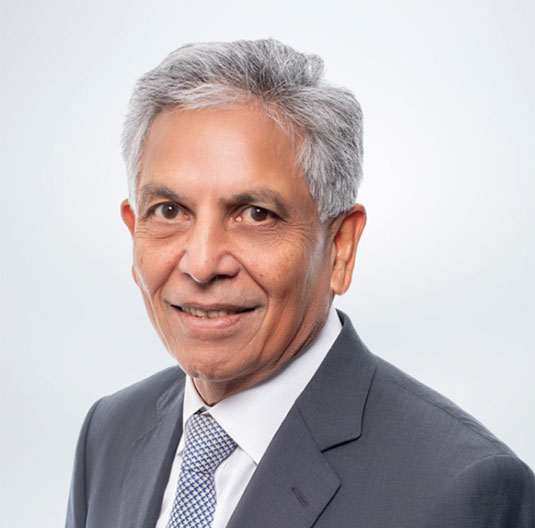
The Age of India: Demographic tailwinds in a Rising Superpower – A Perspective from Shirish Apte
- India has achieved the remarkable feat of becoming the fifth largest, and soon to be fourth largest, economy in the world, just a few years shy of its 80th year since the Declaration of Independence.
- Underpinning India’s upward economic trajectory are fundamental demographic tailwinds: the country’s longstanding emphasis on education, a deep talent pool accompanied by an influx of returning talent, an evolving entrepreneurial mindset within a predominantly young demographic, and a growing middle class with purchasing power that is impacting a wide range of industries.
India is an exciting country with immense potential. In the last few years, the opportunity that India presents as an emerging economic power has become increasingly apparent to the global investment community. This is the result of India’s recent focus on creating the infrastructure needed – physical, regulatory, technology and human capital – to spur investments.
Notably, while India is a globally recognized technology capability centre, in the last 15-20 years, the country has successfully migrated from relatively low-end back-office processing to a range of high-tech value-add services. Government initiatives such as “Make in India” and policies focused on positioning India as a critical contributor to the global supply chain are attracting foreign and domestic capital.
There are a wide range of themes in India that can plausibly offer significant value to investors from real estate and healthcare to tech services and digital payments. Underpinning these trends is a more fundamental tailwind: India’s deep talent pool and the country’s increasing success in talent retention and utilization. This is augmented by a burgeoning culture of entrepreneurialism across India, as evidenced by the number of start-ups across multiple sectors in the economy.
India’s longstanding focus on education has been one of the biggest contributors to its success. In the post-Independence period, the country was blessed to have had two leading Educationists in influential positions – Prime Minister Jawaharlal Nehru and Vice President (later President) Dr. Radhakrishnan. They not only created a culture of education, but actively sought out partnerships with leading engineering and technical Institutes in Europe and in the U.S., such as Imperial College and MIT to establish the Indian Institutes of Technology (“IIT”) and the teaching hospital All India Institute of Medical Sciences (“AIIMS”).
This educational outreach has borne fruit locally and globally. India’s IITs today are recognised among the leading engineering and technical institutes in the world. They, together with the Indian Institutes of Management (IIMs) count CEOs of leading global engineering and technology companies, banks, and even the President of the World Bank as their alumni. The private sector has also contributed with some of India’s leading business houses such as Birla’s (Birla Institute of Technology) and Tata’s (Tata Institute of Fundamental Research, Tata Institute of Sciences among others) further promoting India’s culture of advanced education.
The culture of pursuing advanced education lives on in India today. India’s current government has increased the number of IITs from 5 to 23, covering a range of disciplines, including technology and software. In addition, India has also focused on Medicine, Sciences and Management Studies with the formation of the All-India Institute of Medical Sciences (“AIIMS”, of which 20 are in operation and 5 are under construction), Indian Institute of Sciences (“IIS”) and the Indian Institute of Management (“IIM”). Elsewhere, business schools in management studies such as the Indian School of Business are gaining an excellent reputation.
However, despite the strong culture for education, India suffered from a rapid brain drain in its early post-Independence history. While India was generating a large pool of talent, the country’s industrial policy was mired in the infamous “License Raj”, a period marked by economic stagnation and strict government controls and regulation. As a result, these highly skilled engineers, scientists and management graduates left to find employment elsewhere, and were quickly absorbed in the rapidly industrializing West.
There are signs that this trend is now reversing, with increasing numbers of graduates opting to stay in the country and join or create companies that will benefit from India’s rapid economic growth.
Perhaps more notably, there is evidence that some of the expatriates who left India to study or work abroad are now returning. Some research shows that as many as 60%1 of younger non-resident Indians based in countries such as the US, the UK, Singapore and elsewhere are considering going back to India. As these individuals return, they bring with them world-class expertise in industries such as finance and technology, as well as an international perspective. Many senior academics in leading universities in the U.S. are visiting professors at Indian Universities such as Ashoka and Nalanda Universities.
There is also a second shift among young Indian graduates: they are not only rethinking where to work but are also reconsidering their previously chosen professional path. As young Indians witness manifold examples of domestic entrepreneurs, and Indian companies achieving global success, their perception of risk has evolved. Many graduates now consider launching a startup as a viable career option.
As with many engineering and business programs around the world, students at India’s IITs and IIMs historically sought out jobs in finance and consulting post-graduation. Increasingly, startups are becoming another established pathway for graduates to follow, with each success making it easier for subsequent cohorts. Crucially, this shift has taken place across generations, with many parents supporting their graduating children into taking a more entrepreneurial path.
The resulting emergence of India as a startup hub has been truly staggering – as of April 2024, the Department for Promotion of Industry and Internal Trade recognised more than 149,000 startups in the country2 , up more than a third on 2023. A recent study by Dealroom3 identified that three of the top ten “rising star” tech ecosystems are in India.
This shift does not rely solely on cultural factors; India’s tech ecosystem has benefitted from a concentrated effort to create an infrastructure in which its economy can grow. Global tech companies such as Google, Apple, Amazon, Microsoft and Facebook are setting up development capabilities in India. Silicon Valley start-ups are also using technology hubs in India to develop their systems/products. Global Financial Institutions such as J.P. Morgan, Citi, Goldman Sachs, Standard Chartered and CBA are establishing Global Capability Centers in India to provide tech services, including the monitoring of cybersecurity risks. The positive feedback loop created by technology investment in India driven by tech talent in India, encourages students to opt for engineering and technology qualifications thereby creating a virtuous circle.
This also creates a broad investment opportunity set for those looking to back early-stage startups. The businesses are there and are ready for international investors looking to deploy capital. It is also creating opportunities to benefit the broader growth of the startup ecosystem, such as coworking spaces.
India is already viewed as a technology hub, and the pharmacy to the world. India’s pharmaceutical industry is a significant contributor to its exports. Increasingly, India is now being viewed as a critical link in the global supply chain, in line with the “China + 1” strategy. There are several reasons why India could become a significant player in the global supply chain such as talent pool, young population, land and resources.
India also provides opportunities for manufacturing at scale because of its large and growing domestic market with a population of 1.4 billion. The Central Government has recognised this potential and is insisting on the philosophy of: “if you want to sell in India, you have to make in India”. This was the deal that was offered to Tesla – prohibiting Tesla to sell Chinese-made cars in its domestic market.
India’s emergence as a manufacturing hub, whether it be for iPhones or automobile components, will boost tier II and III cities. Already, we are seeing investments in such locales. This will increase the need for worker housing and warehouse space, in addition to other infrastructure needs such as renewable energy, roads and telecommunications.
Besides, state and central governments, looking to improve employment opportunities for the growing educated class, are providing incentives and subsidies. The recent elections in India were an important signal of what India needs to do over the next 5-10 years. While there have been many significant successes – focus on infrastructure, new enterprises, and new investments; focus on education and strong GDP growth, young voters clearly expressed their disappointment. Youth unemployment remains too high, and this group seeks good jobs. Perhaps some of the education is not appropriately targeted, thereby creating discontent. In its recent budget, the government has shown a clear intent to address this issue.
Nevertheless, for India to become a leading full-service manufacturing /producing country it must overcome several structural and cultural obstacles. Women remain under-represented in the work force. Safety and security concerns, together with cultural norms account for many of these challenges. For example, Foxconn is experimenting with worker housing for women workers at its iPhone production facilities. If successful, this will create opportunities for engaging a larger workforce in the country.
One might think of India’s talent trend as a gradual optimization of its overall talent funnel: its improving ability to retain talent – and even to attract expats back – means it is keeping a higher proportion of the talent it creates. Its burgeoning startup culture means more of this talent is deployed into areas where it might generate far greater levels of innovation and, ultimately, return. The final piece of the puzzle is its growing and increasingly wealthy population, which raises the volume of talent it can produce.
India’s middle class is growing quickly, currently estimated to represent around 31% of the overall population and expected to reach 38% by 20314 . This substantial increase in spending power, and changing consumer behaviour, will have far-reaching implications across many sectors.
One such example is the real estate sector, most notably student housing. India has the second largest higher-education system in the world, and it is growing quickly. The number of students enrolled climbed by nearly 2m last year alone. This, combined with an increasing trend towards students enrolling in universities outside of their home state, is driving the need for more student accommodation and fuelling an enormous investment opportunity.
A growing middle class also presents opportunities for those who can address the demand for soft infrastructure such as hospitals. Healthcare in India has attracted significant attention from global investors5 . We expect this to continue as the country works to fill the remaining gaps in providing medical provision to its enormous population. This can be seen in the rapid construction of new facilities by hospital groups, along with the boom in medtech startups in areas such as early diagnosis.
People are the most valuable resource a nation can have, and India has no shortage of entrepreneurial talent that can carry it into the future. As demand for modern services and infrastructure grows, this will in turn increase the number of opportunities for startups. Because of this, I believe India will continue to thrive.
1 “Increasing Numbers of NRIs Choosing to Return to India in Retirement”, Morningstar
2 Startup India DPIIT recognised startups
3 Top Tech Ecosystems, Dealroom
5 “Private equity targets India’s healthcare sector with record investments”, Financial Times
Related Insights
-
MAY 2025
 Quality Businesses & Management in JapanLearn more

-
MARCH 2025
 Q&A: Rava Partners’ Joe Gagnon and Carl Ge on why Asia Pacific is the next fertile ground in the hunt for assets, returnsLearn more
IREI
-
MARCH 2025
 Véronique Pauwels: Cultivating Versuni’s legacy of innovationLearn more
-
DECEMBER 2024
 India: Emergence of the Digital Payments PowerhouseLearn more
-
NOVEMBER 2024
 Corporate Governance Reforms are enhancing Japan’s Appeal to InvestorsLearn more
-
NOVEMBER 2024
 Cultivating a Performance culture: In conversation with Samuel Wenger, COO of On RunningLearn more
-
SEPTEMBER 2024
 Building a DPM company in the era of hyper-specialization: In conversation with the co-Founders of NovareteLearn more
-
JUNE 2024
 Following the TalentLearn more
-
MARCH 2024
 Resilience to Rally: What Tennis Teaches Us About Business Potential TodayLearn more
FCLT
-
FEBRUARY 2024
 Hillhouse Sees Opportunities in Power Generation, Transport in Climate SectorLearn more
The Korea Times
-
DECEMBER 2023
 The Best Companies are Built in Challenging TimesLearn more
-
NOVEMBER 2023
 Mark Wiseman on the Illiquidity Premium of Private EquityLearn more
-
NOVEMBER 2023
 Hillhouse on “Winning the Loser’s Game” in Private EquityLearn more
-
NOVEMBER 2023
 Hillhouse Chief Predicts ‘Greatest Companies’ Emerging from AsiaLearn more
Bloomberg
-
OCTOBER 2023
 The Challenges to Long-termism in Global InvestmentLearn more
-
AUGUST 2023
 Theresa Whitmarsh on the Private Equity ToolkitLearn more
-
JULY 2023
 The Sustainable Transition: a Progress Update from Singapore – A perspective from Eloy LindeijerLearn more
-
JUNE 2023
 The Next Phase of Private Equity for Institutional InvestorsLearn more
-
FEBRUARY 2023
 The Global Macro TransitionLearn more
GIC
-
NOVEMBER 2020
 Hillhouse on the Largest COVID-19 Impacts on BusinessLearn more
GIC
-
JANUARY 2015
 Perspectives on The Long TermLearn more
FCLT